Researchers and journalists have written some excellent books recently about why Gen AI is so destructive environmentally, economically, culturally, and technologically. Here are some of our recommendations. Please buy these books from an independent retailer, or borrow them from your local library.
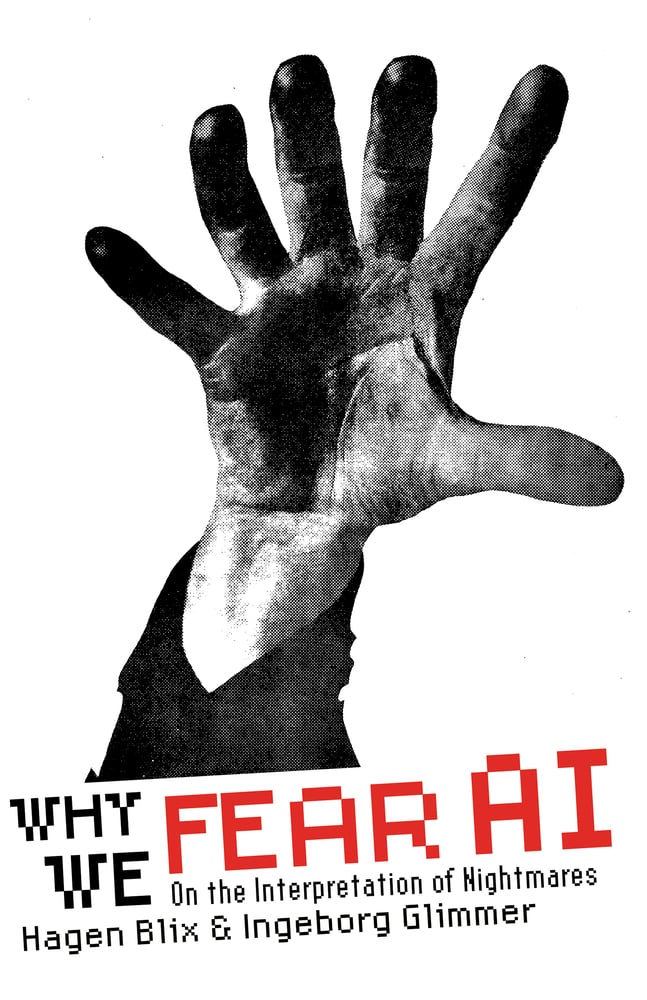
Why We Fear AI: On the Interpretation of Nightmares by Hagen Blix and Ingeborg Glimmer
Blurb from the publisher:
Fears about AI tell us more about capitalism today than technology in the future.
Will AI come and take all our jobs? Will it dominate humanity, hack the foundations of our civilization, or even wipe humans of the face of the planet? All kinds of people seem to think so. From academics to billionaires, artists to fraudsters, journalists to the pope, AI nightmares have gripped the popular imagination. Why We Fear AI boldly asserts these fears are actually about capitalism, reimagined as a kind of autonomous intelligent agent.
Science and tech industry insiders Hagen Blix and Ingeborg Glimmer dive into the dark, twisted, and arcane world of AI nightmares in order to demystify what people say about it. They combine expertise in cognitive science and machine learning with political and economic analyses to cut through the hype and technobabble, and show how fears about AI reflect very different economic realities: from venture capitalists to AI engineers, from artists to warehouse workers at Amazon. If we want to understand the fears and potential impacts of AI, we must think about capitalism, the economy, and class power in real terms we can confront and wage our struggles on.
Blix and Glimmer argue that AI nightmares reveal the terrifying underbelly of our current society, of the violence and alienation at the root of capitalism and its way of organizing our world in its image. If we simply let capitalism and tech billionaires run wild, we can expect the worst: automated bureaucracies that protect the powerful and punish the poor; an ever-expanding surveillance apparatus; the cheapening of skills, downward pressures on wages, the expansion of gig-work, and crushing inequality. But that outcome is not inevitable, however much capitalist may dream of it. Why We Fear AI points the way to a different and brighter future, one where our labor, knowledge, and technologies serves us, rather than us serving capital and its owners.
Bookshop.org: https://bookshop.org/p/books/why-we-fear-ai-on-the-interpretation-of-nightmares-hagen-blix/21051186
Borrow from your local library, via OpenLibrary.org: https://openlibrary.org/works/OL42748903W/Why_We_Fear_AI?edition=key%3A/books/OL58187316M

Blood in the Machine: The Origins of the Rebellion Against Big Tech by Brian Merchant
Blurb from the publisher:
“The most urgent story in modern tech begins not in Silicon Valley but two hundred years ago in rural England, when workers known as the Luddites rose up rather than starve at the hands of factory owners who were using automated machines to erase their livelihoods.
The Luddites organized guerrilla raids to smash those machines—on punishment of death—and won the support of Lord Byron, enraged the Prince Regent, and inspired the birth of science fiction. This all-but-forgotten class struggle brought nineteenth-century England to its knees.
Today, technology imperils millions of jobs, robots are crowding factory floors, and artificial intelligence will soon pervade every aspect of our economy. How will this change the way we live? And what can we do about it?
The answers lie in Blood in the Machine. Brian Merchant intertwines a lucid examination of our current age with the story of the Luddites, showing how automation changed our world—and is shaping our future.”
Official website (from publisher Little, Brown): https://www.hachettebookgroup.com/titles/brian-merchant/blood-in-the-machine/9780316487740/
Bookshop.org for hardback and audiobook: https://bookshop.org/p/books/blood-in-the-machine-the-origins-of-the-rebellion-against-big-tech-brian-merchant/
Bookshop.org eBook: https://bookshop.org/p/books/blood-in-the-machine-the-origins-of-the-rebellion-against-big-tech-brian-merchant/
Borrow from your local library, via OpenLibrary.org: https://openlibrary.org/works/OL27138995W/Blood_in_the_Machine?edition=key%3A/books/OL58505265M
Brian also maintains a blog that’s critical of Gen AI, which he frequently updates: https://bloodinthemachine.com
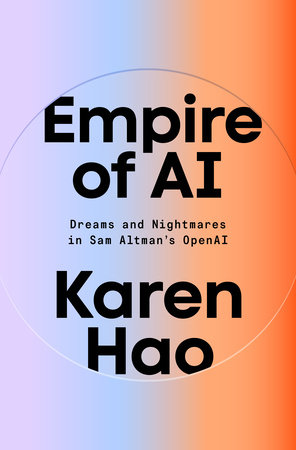
Empire of AI by Karen Hao
Blurb from the publisher:
“From a brilliant longtime AI insider with intimate access to the world of Sam Altman’s OpenAI from the beginning, an eye-opening account of arguably the most fateful tech arms race in history, reshaping the planet in real time, from the cockpit of the company that is driving the frenzy
When AI expert and investigative journalist Karen Hao first began covering OpenAI in 2019, she thought they were the good guys. Founded as a nonprofit with safety enshrined as its core mission, the organization was meant, its leader Sam Altman told us, to act as a check against more purely mercantile, and potentially dangerous, forces. What could go wrong?
Over time, Hao began to wrestle ever more deeply with that question. Increasingly, she realized that the core truth of this massively disruptive sector is that its vision of success requires an almost unprecedented amount of resources: the ‘compute’ power of high-end chips and the processing capacity to create massive large language models, the sheer volume of data that needs to be amassed at scale, the humans “cleaning up” that data for sweatshop wages throughout the Global South, and a truly alarming spike in the usage of energy and water underlying it all. The truth is that we have entered a new and ominous age of empire: only a small handful of globally scaled companies can even enter the field of play. At the head of the pack with its ChatGPT breakthrough, how would OpenAI resist such temptations?
Spoiler alert: it didn’t. Armed with Microsoft’s billions, OpenAI is setting a breakneck pace, chased by a small group of the most valuable companies in human history—toward what end, not even they can define. All this time, Hao has maintained her deep sourcing within the company and the industry, and so she was in intimate contact with the story that shocked the entire tech industry—Altman’s sudden firing and triumphant return. The behind-the-scenes story of what happened, told here in full for the first time, is revelatory of who the people controlling this technology really are. But this isn’t just the story of a single company, however fascinating it is. The g forces pressing down on the people of OpenAI are deforming the judgment of everyone else too—as such forces do. Naked power finds the ideology to cloak itself; no one thinks they’re the bad guy. But in the meantime, as Hao shows through intrepid reporting on the ground around the world, the enormous wheels of extraction grind on. By drawing on the viewpoints of Silicon Valley engineers, Kenyan data laborers, and Chilean water activists, Hao presents the fullest picture of AI and its impact we’ve seen to date, alongside a trenchant analysis of where things are headed. An astonishing eyewitness view from both up in the command capsule of the new economy and down where the real suffering happens, Empire of AI pierces the veil of the industry defining our era.”
Official website (from publisher Penguin Random House): https://www.penguinrandomhouse.com/books/743569/empire-of-ai-by-karen-hao/
Bookshop.org for hardback, eBook, and audiobook: https://bookshop.org/p/books/empire-of-ai-dreams-and-nightmares-in-sam-altman-s-openai-karen-hao/22156498
Borrow from your local library, via OpenLibrary.org: https://openlibrary.org/works/OL42453624W/Empire_of_AI?edition=key%3A/books/OL57607210M

Digital Safety in a Dangerous World by Kim Crawley (that’s me!)
Blurb from the publisher (also me!):
When Jeff Bezos, Mark Zuckerberg, and Elon Musk were seen front and center at Donald Trump’s second inauguration, it sent a clear message. Washington DC, Silicon Valley, and Mar-a-Lago are all united. These are your overlords, and they will Make America Great Again!
Musk infamously Nazi saluted. And in the months that followed, his “DOGE” destroyed much of the tiny bit of US social services that were left.
People live their everyday lives on their phones, on social media, on platforms owned by these overlords.
Whether or not you’re marginalized, the modern internet and computer technology platforms we’ve been pushed into using everyday are now a massive surveillance and propaganda surface that fascist governments in the United States and its allies in the Five Eyes and NATO are fully leveraging.
Even if you’ve never been to a pro-Palestine protest, your Instagram post about how much you hate the ice on the roads will likely be misinterpreted by a Gen AI bot to mean that you plan to harm ICE, a rapidly growing fascism enforcement arm of the US government. Being thrown into a concentration camp, even if you’re a citizen, for making a social media post about bad winter driving conditions, isn’t a bizarre horror from William Gibson anymore. It’s our reality, in 2026 and beyond.
Kim Crawley is a former enterprise cybersecurity professor, and the founder of Stop Gen AI. She used to play by Silicon Valley’s rules to assure that her rent was paid. Now the tech industry no longer assures her of housing and food, so all the “professionalism” she maintained is no more.
Get the uncensored and well researched truth about the relationship between fascism and computer technology in the 2020s and beyond.
Understand historical context. And learn how to greatly reduce your odds of getting into trouble with fascist police, through sound cybersecurity and operational security tips that you won’t get from entities that are trying to sell you products and services.
Crawley has made an effort to make her technical advice easy for laypeople to understand.
Meanwhile, her immense personal struggles and strong anticapitalist views provide context to the practical ideas in the book.
Learn what you need to know to avoid Gen AI, and to use social media, phones, and PCs in ways that will make you and the people you care about a lot safer in this technofascist hellworld we’re in now.
You deserve Digital Safety in a Dangerous World.
Retail links for eBook from Kobo, Smashwords, and more: https://books2read.com/u/meQk7V
Amazon Kindle eBook and paperback via Amazon is here: https://www.amazon.com/Digital-Safety-Dangerous-World-Crawley/dp/B0GDTP1G21

NoToBigTech.org is an excellent resource. Big Tech is the greatest menace upon our lives.
Stop Gen AI has been included in their resources.
Please check out the rest of the site, as well.

Alexia maintains a resource of software that lacks Gen AI: Starlight Network No-AI List
“Generative AI, namely LLMs, image and video diffusion models and especially the companies that make them plague the tech industry.
We got tired, so we decided to take things into our own hands and curate a list of projects that aren’t complicit in the devaluing of labor by these companies.
Unlike projects that came before us, we want to highlight software that values the labor that goes into creating and not call out projects that use LLMs or Image/Video Diffusion models.”

Stop Gen AI group member Emmi Einstein pointed out this awesome set of web browser extensions to me. It’s Slop Evader.
“This is a search tool that will only return content created before ChatGPT’s first public release on November 30, 2022.”
The extensions are for the desktop versions of Google Chrome and Mozilla Firefox. It’s created and maintained by Tega Brain Studio.
Check it out: https://tegabrain.com/Slop-Evader

Olivia Guest is a computational scientist who is leading the fight against Gen AI, especially in academia.
Most of her research on the various psychological, social, and academic harms of Gen AI is on her Critical AI website.
Check it out: https://olivia.science/ai
Pivot to AI by David Gerard is worth following. Every day David creates a snappy approximately five minute video podcast that correctly bashes the Silicon Valley Gen AI torment nexus and the clankers who follow it in a dazed trance. So far he mainly focuses on ridiculous Gen AI technological, organizational, and financial blunders.
Blog:
YouTube:
https://www.youtube.com/@PivotToAI
Audio podcast:
Here are a couple of sample videos for you to enjoy, as they’re short and sweet:
Doing independent media is tough, so consider buying some Pivot to AI merch: https://www.redbubble.com/people/pivot-to-ai/
Or pitching into David’s Ko-Fi: https://ko-fi.com/A1529D5
Steve Farrugia is a a developer, and he has a lot of well constructed thoughts and strong opinions about computer technology. Some of his opinions are about Gen AI (we agree that it’s fucked up, of course), and some of his opinions is about other Silicon Valley bullshit too. Frankly the industry hasn’t invented anything that’s genuinely good innovation since the early 2010s.
Faster and Worse blog
Faster and Worse YouTube
tante’s Smashing Frames blog has lots of great anti-Gen AI ideas.
404 Media continues to do excellent Gen AI-skeptical news coverage: https://www.404media.co/tag/generative-ai/
Most posts on Futurism these days are critical of Gen AI: https://futurism.com/
Neil Turkewitz has lots of thoughtful criticism on his blog: https://medium.com/@nturkewitz_56674
We must mention Brian Merchant’s blog, once again: https://www.bloodinthemachine.com/
His “AI Killed My Job” is here: https://www.bloodinthemachine.com/s/ai-killed-my-job
Nightshade application from computer scientists Shawn Shan, Wenxin Ding, Josephine Passananti, Haitao Zheng, and Ben Y. Zhao at the University of Chicago. Using this tool to render your original digital art files may protect your art from DALL-E and similar graphical Gen AI plagues: https://nightshade.cs.uchicago.edu/whatis.html
Laureen Hudson is a cybersecurity journalist with an excellent new blog. It’s not all about Gen AI, but it’s an easy recommendation: https://cybersecuritea.com/
Check out Neha’s Nebula’s Code blog! A Stop Gen AI member who does machine learning research: https://nebulascode.com/
Nye Canham’s Generative AI: The aesthetics of Fascism
Dr. Mél Hogan’s The Data Fix podcast. They are a critical media studies scholar and a lot of episodes are related to the horrors of Gen AI.
If you have a book or online resource you’d like to see here, whether it’s yours or someone else’s, please let us know! Email Kim Crawley at kim.crawley (at) stopgenai (dot) com